Thursday, March 5, 2009
Thesis
College campuses across the nation need to raise standards for collegiate behavior by enforcing laws and holding college students accountable for their actions. With this change, society will realize that college students do not abuse alcohol and drugs as much as the media would like us to believe, thus lowering the amount of alcohol consumed by college students.

Definition of the Controversy
 http://www.beerbooks.com/images/products/med/4129.jpg
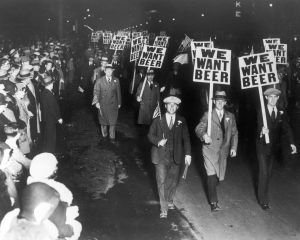
Alcohol has been around for centuries, and people to this day try to determine how much is too much. During the early 1900’s, Congress ratified the 18th Amendment to the Constitution stating that all sale, production, and consumption of alcohol was banned. This was known as Prohibition. The legislation was enacted in an effort to clean up society. As the Great Depression crept into United States history in the late 1920’s, Prohibition became very unpopular. Even back then, authorities could not keep alcohol out of the hands of society. Illegal dealings began to take place to distribute and sell alcohol. In 1933, the 18th Amendment was repealed.


During the Vietnam War, the idea of a legal drinking age being 21 came into question. The argument was if men the age of 18 or older are allowed to vote and serve in war, then they should also be permitted to drink alcohol. During that era, the drinking age was lowered to 18 years. But, due to the increase in car accidents, the drinking age was raised back to 21 through the National Minimum Drinking Age Act of 1984. The Act states:
"The National Minimum Drinking Age Act of 1984 required all states to raise their minimum purchase and public possession of alcohol age to 21. States that did not comply faced a reduction in highway funds under the Federal Highway Aid Act. The U.S. Department of Transportation has determined that all states are in compliance with this act"(U.S Dept of Transportation).

http://media.collegepublisher.com/media/paper287/stills/x7d0698m.jpg

Nowadays, the problem is not so much keeping the alcohol away from society as it is keeping it out of the hands of those under 21. Most college students are right at the edge of the legal age, but that doesn’t stop them. On college campuses across the country, underage drinking is becoming a serious problem. Students have a perception of college life as one big party like it is portrayed in movies such as Animal House and music like Asher Roth’s “I Love College.” Students come into college thinking that everyone is experimenting with drugs and alcohol, which simply isn’t true.

http://www.politefiction.com/wp-content/uploads/2008/06/animal_house.png

Several researchers have come up with potential solutions. For example, Henry Wechsler, a social psychologist at Harvard University, wants to implement a prevention program known as “environmental protection”(Park 1). This program would attack all that promoted alcohol to underage drinkers such as local bars and liquor advertisers. The program would provide dorms that are free of alcohol. Wechsler wants to keep alcohol as hidden from those under 21 as possible. This includes training restaurants how to handle underage drinkers and going after businesses that break the minimum drinking age laws.
 http://www.conservativecartoons.com/1994/bars.gif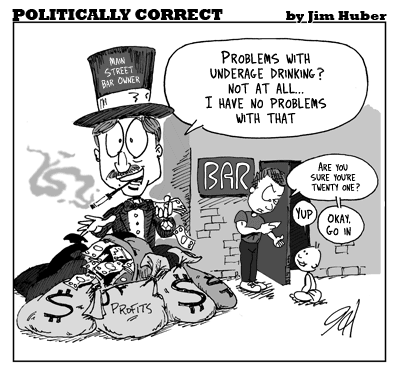
Another approach is the “social norms” strategy. This program would serve as a campaign to inform students that their peers do not consume as much alcohol as it appears in the media.This method was introduced by H. Wesley Perkins and Alan D. Berkowitz. Berkowitz describes the definition of the social norms strategy by stating, "our behavior is influenced by incorrect perceptions of how other members of our social groups think and act." This method is based on the effects of peer pressure. Berkowitz states, "Social norms interventions focus on peer influences, which have a greater impact on individual behavior than biological, personality, familial, religious, cultural and other influences." This strategy depends on changing the way incoming college students see the party atmosphere. Social norms would try to bring truth to the misperceptions of college drinking by showing students that not all of their peers participate in this illegal behavior.


Illustration of the Problem
Tracie Dungan, Arkansas Democrat Gazette, "Parents provide unity, publicity on alcohol abuse"
 http://www.gordie.org/getattachment/296bf41e-c38f-494b-a93e-974903f509a1/Raheem-Bath.aspx
Raheem Bath, 20, a junior at Duke University in Durham, North Carolina, went out with some friends to have a good time. He wanted to forget about the pressures of college for just one night. This sounds like such a common desire of most college drinkers. Bath decided to go on a drinking binge like most college students do, right? Bath ended up in the hospital for a week before passing away. What was the cause of death? Aspiration Pneumonia. As it turns out, that night of heavy drinking caused Raheem Bath to pass out and choke on his own vomit starting a fatal bacterial infection in his lungs.
 http://wwwcache.wral.com/asset/news/local/2000/02/17/150376/712595-220x165.jpg

Bath's mother, Catherine, spoke at his campus memorial service. She gave his fellow friends a warning in Raheem's own words. She said, "I told them what he had said to his best friend before he died: 'If I make it through this, I'm never touching alcohol again.'" Raheem understood the dangers of binge drinking, so why did he continue to put himself in harm's way? Maybe it was because he felt that heavy drinking was such a common practice and nothing would happen.
 http://media.collegepublisher.com/media/paper884/thumbs/t_3d7689755fd4d-14-2.jpg

Catherine Bath has devoted her life to making sure that no underage drinker ever goes into a night of heavy drinking with this idea. She wants to save parents everywhere from the pain that she had to go through with the loss of her son to underage college drinking. Bath stated, "It just kills me to see these college kids drinking. People say, oh, it's just a phase they're going through. But you know what? They don't all live through it."
Subscribe to:
Posts (Atom)